I am delighted to contribute this piece to the beautiful exhibition “Cosmos - the art of observing space” at the Royal west of England Academy, curated by Ione Parkin. Here is the painting and supporting words written for the exhibition catalogue.
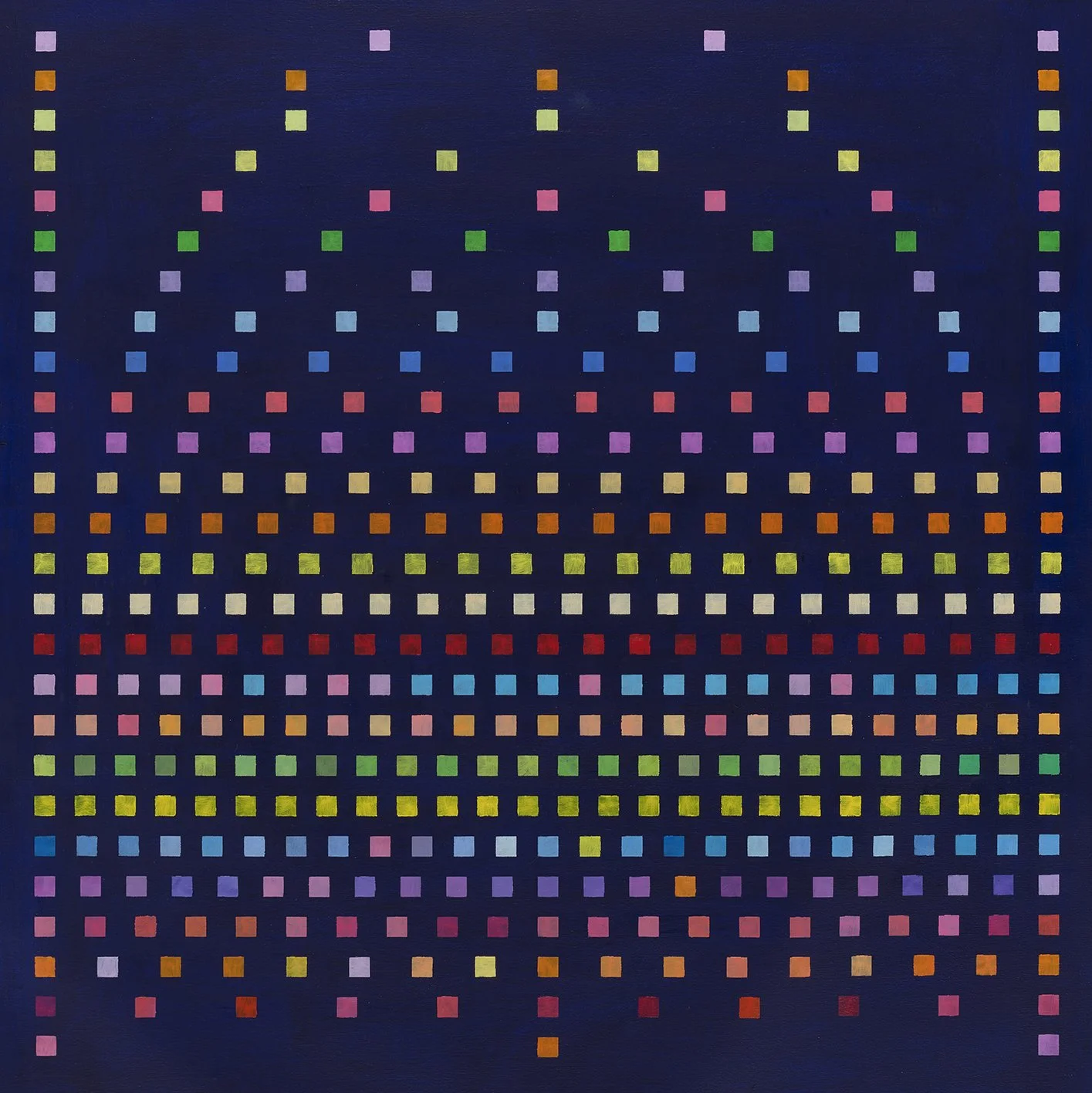
400 Droplets of Cosmic Light in every Cubic Centimetre
2025
Oil on canvas
100cm x 100cm
Photography credit: Prudence Cuming
All space is filled with light from the Big Bang, and this Cosmic Microwave Background (CMB) constitutes about 97% of all the light in the observable universe. The CMB image, shaped like an egg, represents this light as captured by a satellite. Imagine it as a vast speckled sky, where each spot is roughly the size of the Moon as seen from Earth. If our eyes could detect microwave light, we would see this pattern painted across the sky. The speckles show tiny temperature variations, differing by about one part in 100,000. Scientists have artificially coloured them red, yellow, and blue to highlight these variations, but the choice of colours is arbitrary.
Many of us have unknowingly encountered the CMB as a faint crackle on old-fashioned radios. First predicted in 1948 by Ralph Alpher and Robert Herman as ‘Relic Radiation,’ the CMB was identified in 1964 by Arno Penzias and Robert Wilson, who initially mistook the signal for interference caused by pigeon droppings inside their radio telescope. Their groundbreaking discovery was published under the understated title: “A Measurement of Excess Antenna Temperature at 4080 Mc/s.”
Scientists believe that the story of the CMB begins with the birth of the Universe as an immensely dense, tiny hot dot. Tiny quantum fluctuations emerged, triggering vast oscillations in matter and light, laying the foundation for cosmic structures. As the Universe expanded and energy dispersed, matter became neutral, allowing light to travel freely for the first time. This most ancient light – the CMB – carries an imprint of the infant Universe, showing the earliest structures that would evolve into galaxies and stars.
I have long been fascinated by the first light, exploring it through writing and sketched animations to deepen my understanding of its origins. I wanted to explore a more personal perspective by asking the question, “How much of this cosmic light is touching me?”. The answer: there are around 400 invisible photons of this remarkable ancient light in every cubic centimetre – think of the small space occupied by the tip of your little finger. In this painting I have organised them by energy, with the highest energy photons at the top. They float against an inky background of deep blue layers evoking bright beginnings, stars and ancient seeds.